Tour Operator Feedback: How to Collect Reviews During the Tour (Not After)
Learn why post-tour emails fail and how Thailand tour operators capture guest feedback in real-time using QR codes, guide prompts, and the bus moment strategy.
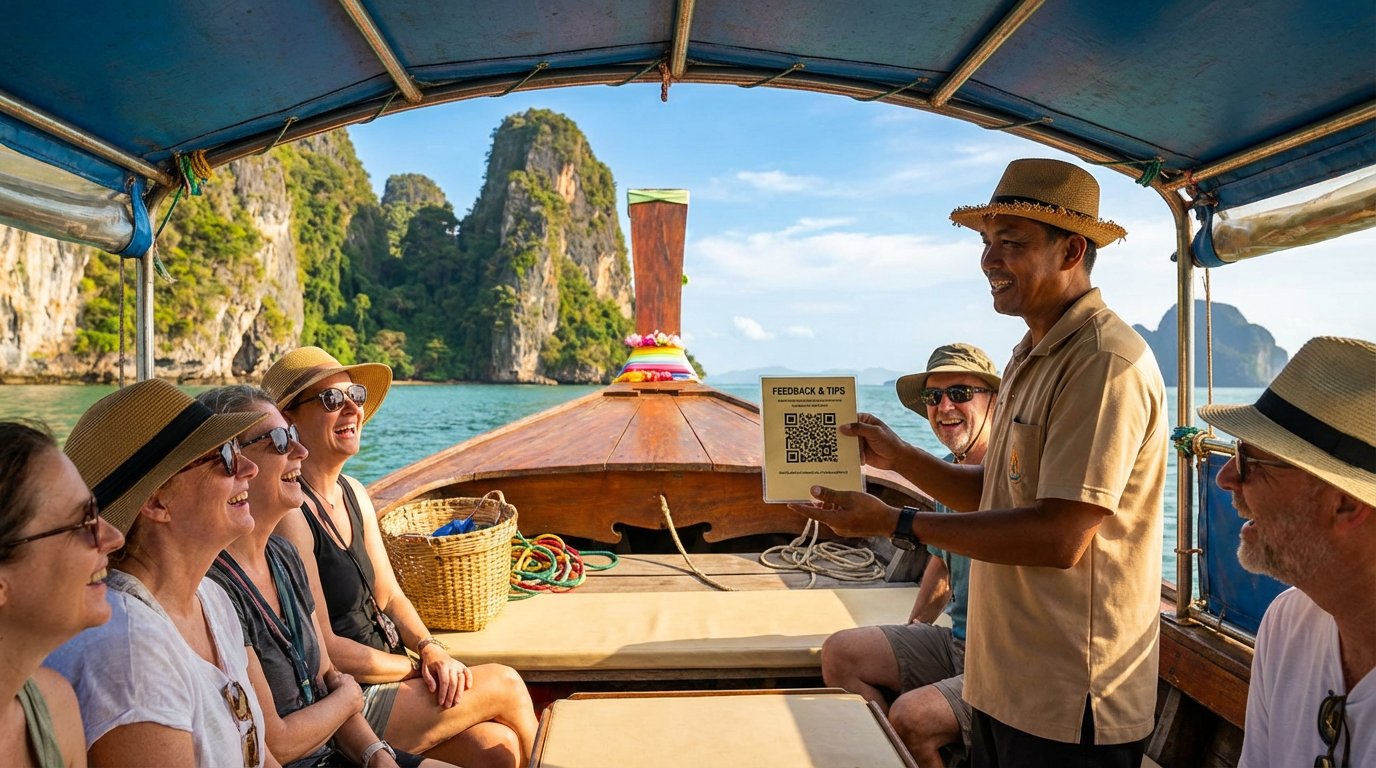
A guest finishes your Phang Nga Bay island-hopping tour at 5 PM. By 7 PM, they are having dinner in Patong. By tomorrow morning, they are flying to their next destination. Three days later, when your post-tour email arrives, they are back home in Sydney or Munich, overlooking your feedback request while catching up on work emails.
This timing issue shapes how tour operators collect feedback. Unlike hotels, where guests stay for several nights, or restaurants, where diners linger over dessert, tours wrap up quickly. The guest experience ends, the group breaks up, and soon after, your customers have either traveled to other parts of Thailand or returned to their home countries.
In 2024, Thailand welcomed 35 million international visitors, generating over 1.8 trillion baht in tourism revenue. Tours and activities make up a significant part of that spending. Still, tour operators often find it hard to gather the feedback that influences TripAdvisor rankings and repeat bookings.
The solution is simple: collect feedback during the tour, not after it ends.
Why Post-Tour Emails Fail
Tour operators face feedback problems that hotels and restaurants do not encounter. The structural issues with post-tour email surveys make them almost useless for many operators.
Timezone issues. When your tour wraps up in Chiang Mai at 4 PM local time, your guest from London is already shifting their focus to evening activities. By the time they receive your email 24 to 48 hours later, they are awake during hours when you are asleep. The gap between “that tour I took” and “my inbox right now” widens with every hour that passes.
Vacation memory fade. International tourists in Thailand often pack several activities into each day: temple visits, cooking classes, elephant sanctuaries, snorkeling trips, and night markets. By day five of a two-week trip, individual experiences start to blur together. The details of your tour that could help a review become lost in the mix.
Return-to-work stress. The guest who was happily taking pictures at James Bond Island is now buried under 200 unread work emails. Your feedback request competes with their boss, mortgage company, and pressing project deadlines. While your tour was wonderful, it cannot compete with the pressures of returning to everyday life.
The international tourist issue compounds the problem. Domestic tourists may see your follow-up email while still enjoying vacation mode. However, international visitors—who often represent higher-value bookings and more impactful reviews—have already shifted their focus by the time they receive your email.
Do the math: if only 6 to 10% of guests reply to post-tour emails, and only a small number of those leave public reviews, a tour operator running 50 tours per month with 15 guests each might get just 5 to 10 reviews every month. Given TripAdvisor’s ranking algorithms, which favor recency and volume, this pace falls short compared to operators that collect feedback in real time.
The Tour Feedback Timeline
Different tour formats create different chances for feedback. Understanding your timing constraints helps determine which strategy works best.
Day Tours: One Chance at Tour End
Single-day tours provide one realistic feedback window: the final 15 to 30 minutes before the group breaks up.
The return journey. For tours that involve transport back to pickup points, the return trip is the best time for feedback. Guests are seated, have their phones out, and the experience is still fresh. A Krabi four-island tour returning by speedboat has 20 to 30 minutes of transit time, ideal for gathering feedback.
The end-of-tour gathering. Before releasing the group, guides can create a structured moment for feedback. This approach works especially well at fixed drop-off points where guests briefly wait before separating.
What does not work: Asking for feedback during the highlight moment of the tour. When guests are snorkeling in clear water or watching elephants, they are not thinking about surveys. Capture those experiences first and request feedback during the transitions afterward.
Poor Timing
- During peak activity moments
- While guests are eating lunch
- In the middle of cultural experiences
- At the very beginning, before value is delivered
- After guests have already separated
Optimal Timing
- During the return journey in a vehicle
- At the final gathering before dispersing
- During the transition between activities
- After lunch during a rest period
- While waiting for transportation
Multi-Day Tours: Mid-Tour Check-Ins
Multi-day itineraries allow for multiple feedback opportunities, enabling both service recovery and final assessments.
Day two evening check-in. For tours lasting three days or longer, a brief check-in during the second night allows for adjustments. If the guide is moving too fast, hotel accommodations are disappointing, or meal quality is inconsistent, mid-tour feedback allows for corrections before the experience concludes.
Final morning before departure. The last day of a multi-day tour should include dedicated time for feedback. Guests have the full context of their experience and are mentally present with the group.
Daily micro-feedback. Some operators use brief daily check-ins with two questions: “How was today?” and “Is there anything we should change for tomorrow?” This approach requires little effort from guests while providing ongoing improvement signals.
The Bus Moment: Capturing Feedback During Transit
Transit time offers an overlooked chance for feedback. The “bus moment” strategy recognizes that guests seated in vehicles have their phones at hand and time available.
Factors that make bus moments effective:
- Guests have their phones accessible
- No other competing activities
- The group dynamic encourages participation
- The guide can prompt verbally
- It remains within the context of the tour experience
Implementation: The guide announces the feedback collection 5 to 10 minutes into the return trip, displays the QR code, and offers a brief explanation that feedback helps improve experiences for future guests.
Guide-Level Feedback Without Creating Conflict
Tour guides are not just employees—they are the product. A knowledgeable, engaging guide can turn an ordinary itinerary into a memorable experience. A disengaged or unprepared guide, however, can undermine even the most spectacular destination.
Collecting guide-specific feedback is crucial for improving operations but needs to be handled carefully to avoid defensive reactions and interpersonal issues.
Why Guide Feedback Matters
Review analysis across major platforms reveals consistent patterns. Guests often mention guide names, describe specific interactions, and attribute overall satisfaction mainly to the person leading their experience. A tour of the same locations with different guides can yield very different reviews.
For tour operators, this means:
- Guide performance directly influences review scores
- Underperforming guides can harm reputation faster than any other factor
- High-performing guides deserve recognition and investment in retention
- Consistent feedback allows for coaching rather than guessing
Building Fair Assessment Systems
Guide feedback systems that feel punitive can create resistance. Systems that seem developmental encourage participation.
Aggregate Over Time
No single tour’s feedback should determine guide assessment. Patterns across 20 or more tours reveal consistent strengths and areas for growth.
Contextualize Scores
A guide leading a tour in monsoon rain or managing a complex group deserves context. Raw scores without context create unfair comparisons.
Focus on Development
Frame feedback as input for coaching, not as performance judgment. Saying “This helps us support your professional growth” works better than “We’re tracking your scores.”
Question design matters. Instead of asking guests to “Rate your guide 1-5,” use specific behavioral questions:
- “Did the guide explain historical and cultural context clearly?”
- “Did the guide ensure everyone in the group felt included?”
- “Did the guide handle timing and logistics smoothly?”
These questions provide concrete feedback for coaching rather than abstract ratings.
Using Feedback for Training
Raw scores simply tell guides if they are performing well or poorly. Specific feedback illustrates what needs to change.
Monthly feedback reviews. Share anonymized guest comments with individual guides. For instance, “Three guests this month appreciated your photography tips at temple locations” reinforces effective behaviors. “Two guests mentioned feeling rushed at the elephant sanctuary” points out areas for adjustment.
Peer learning sessions. Top-performing guides can share techniques that lead to positive feedback. Asking, “What do you do during the return journey that guests seem to appreciate?” facilitates knowledge transfer without criticism.
Guide involvement in survey design. When guides help determine what questions to ask, they take ownership of the feedback process and do not see it as surveillance.
Weather and Disruption Feedback
Thailand’s weather is unpredictable. Monsoon season, from May to October, brings afternoon downpours. Andaman Sea conditions can cancel island transfers. Smoke season in the north reduces visibility. These factors are beyond the operator’s control but can significantly affect the guest experience.
Setting Expectations Proactively
Guest satisfaction during disruptions is more closely linked to managing expectations than to the actual conditions.
Pre-booking communication. Seasonal disclaimers that explain possible weather conditions help prepare guests for potential changes. “Monsoon season tours may experience brief afternoon rain showers. We provide rain gear and adjust itineraries as needed.”
Morning briefings. On uncertain weather days, guides who address conditions directly (“We may have some rain this afternoon, but we have covered alternatives planned”) prepare guests psychologically and reduce disappointment.
Real-time updates. If conditions change during the tour, immediate and clear communication is more effective than trying to downplay or hide the situation.
Service Recovery During Tours
When weather necessitates significant changes to the itinerary, how the situation is handled greatly influences the guest’s overall perception.
Acknowledge Immediately
Don't act as if the rain isn't occurring. Clearly state the situation: 'The weather has changed our plans today.'
Present Alternatives
Provide specific alternatives instead of vague reassurances. 'Instead of the beach, we'll visit the covered market and extend our cooking class.'
Add Unexpected Value
Disruptions offer chances for memorable service recovery. Complimentary drinks, extended experiences at covered locations, or small gifts can positively change the narrative.
Request Feedback on Recovery
Ask directly: 'Given the weather change, how did you feel about the alternatives we provided?' This shows you care about their experience despite the conditions.
Getting Good Reviews When Conditions Are Bad
Interestingly, some of the most positive reviews come from guests who faced problems that were resolved exceptionally well.
The service recovery paradox applies to tours: guests who experience an issue and see it handled effectively often become more loyal than those who never face a problem. A guide who manages weather disruptions with care and creativity can receive reviews that specifically commend how the situation was addressed.
Example guest review narrative: “Our snorkeling got canceled due to rough seas, but our guide took us to a fantastic local restaurant instead. The afternoon at the hot springs made up for everything. The way they handled the change showed real professionalism.”
Feedback collected during disrupted tours should focus on the recovery experience, not just overall satisfaction with the tour.
QR Codes for Tours: Where and When
QR code feedback collection works differently for tours than for fixed-location businesses. Guests are mobile, internet connectivity varies, and there is no natural “table” or “room” for signage. Success comes from considering the guest’s context throughout the tour.
For comprehensive QR implementation strategies, see the QR Codes for Guest Feedback Implementation Guide. The following covers tour-specific applications.
Welcome Packet Placement
Guests receive materials at the start of the tour: itineraries, safety information, and vouchers. Including a feedback QR code in this packet sets the expectation early.
Advantages:
- Establishes that feedback is welcome
- Provides the code before guests misplace materials
- Works for guests who prefer immediate mobile access
Limitations:
- Most guests will not scan immediately
- Paper can get wet, lost, or thrown away
- Feedback at the start of the tour lacks experience context
Best practice: Include a QR code in the welcome materials, but don’t depend on it as the main collection method.
End-of-Activity Moment
Transitions between activities create natural opportunities for feedback.
Examples:
- After returning from snorkeling to the boat
- After completing the cooking class portion of a food tour
- After the elephant interaction ends
- Following the temple visit before lunch
These moments are effective because guests have just finished an activity worth commenting on and have a brief pause before the next one begins.
Implementation: The guide holds a laminated QR code card and says: “If you’d like to share your thoughts on [activity just completed], scan this code. It takes 30 seconds.”
Vehicle Placement
For tours involving buses, vans, or boats, permanent QR displays allow for passive feedback collection throughout the day.
Ineffective Placement
- On the vehicle exterior (can't scan from inside)
- A single code at the front (back-row guests can't see)
- A small code on a dark surface (difficult to scan)
- Hidden among other signage (easily overlooked)
Effective Placement
- Seatback cards visible from the passenger seat
- Multiple codes throughout larger vehicles
- High-contrast design on weatherproof material
- Clear 'Share Your Feedback' messaging
Technical consideration: Ensure the feedback form loads quickly and works with limited connectivity. Many tour locations have poor cellular coverage. A form that takes 30 seconds to load is unlikely to be completed.
Guide-Prompted Scanning
The most effective method for collecting feedback on tours is when the guide directly asks guests to scan and share their thoughts.
Why guide prompts work:
- A verbal request adds social accountability
- Guests respond to the guide’s direct ask
- Timing is optimized by someone familiar with the tour flow
- A personal relationship boosts participation
Sample guide script: “Before we finish today, I’d really appreciate your feedback on the tour. It helps me improve and assists future guests in knowing what to expect. If you have 60 seconds, scan this code and share your thoughts. Being anonymous is fine.”
This approach combines a personal request, a clear time expectation, and an option for anonymity, addressing common guest hesitations.
Implementation Roadmap
Transitioning from post-tour email surveys to real-time feedback collection requires changes in operations. Start small, test what works for your specific tours, and then expand.
Week 1: Audit Current State
Calculate your actual post-tour email response rate. Review recent TripAdvisor reviews to find out what guests mention most. Identify your highest-volume tour for the pilot.
Week 2: Design and Deploy
Create a mobile-friendly three-question survey. Generate QR codes for the pilot tour. Brief guides on the collection script and timing. Prepare laminated QR cards for vehicle and guide use.
Week 3: Pilot One Tour Type
Focus feedback collection on your pilot tour only. Test different timing points (end of activity, return journey, final gathering). Track response rates by timing method.
Week 4: Analyze and Adjust
Compare pilot response rates to the post-tour email baseline. Identify which timing method produced the highest completion. Gather guide feedback on what worked. Refine the approach before expanding.
Metrics to Track
| Metric | Target | Why It Matters |
|---|---|---|
| In-tour response rate | 30-40% | Measures collection effectiveness |
| Survey completion rate | 80%+ | Indicates appropriate survey length |
| Guide-specific feedback | 60%+ include guide comments | Confirms guide assessment ability |
| Time to TripAdvisor review | Within 72 hours | Real-time collection allows for prompt posting |
| Negative feedback interception | 2:1 internal vs. public | Addresses issues before they generate reviews |
Common Implementation Challenges
Challenge: Guides resist feedback collection as extra work. Solution: Frame feedback as enhancing their professional reputation. Include guide recognition based on positive feedback. Share compliments directly with guides.
Challenge: Guests feel rushed at the end of the tour. Solution: Build 5-10 minutes of dedicated feedback time into the itinerary. Position it as “reflection time” instead of a survey obligation.
Challenge: Connectivity issues at remote locations. Solution: Use offline-capable survey forms that sync when connectivity is restored. Time feedback collection for transit periods when passing through coverage areas.
Challenge: Multi-language guest groups. Solution: Ensure feedback forms have language options. Brief guides on how to prompt in multiple languages if needed.
Frequently Asked Questions
What's a realistic response rate target for tour feedback?
Should feedback be anonymous or linked to bookings?
How do we handle negative feedback about specific guides?
What survey length works best for tour feedback?
How do we handle feedback during weather disruptions?
Can we ask guests to post TripAdvisor reviews directly?
Ready to capture tour feedback in real-time? GuestMetrix helps tour operators collect guest sentiment during the tour experience, route guide-specific feedback appropriately, and convert satisfied guests into TripAdvisor reviewers. Start your free pilot and see how in-moment feedback transforms your review profile.
Related Articles
- Thailand Hospitality Challenges and Solutions for 2025 - Market context and tourism trends
- QR Codes for Guest Feedback: Complete Implementation Guide - Detailed QR deployment strategies
- NPS, CSAT, and CES: Which Metrics Matter for Hospitality? - Choosing the right metrics for tour feedback
- How to Prevent Bad Hotel Reviews Before They’re Posted - Service recovery principles applicable to tours
Sources
- Thailand welcomes over 35 million visitors in 2024 - Tourism Authority of Thailand
- Thailand Tourism Statistics 2025 - GoWithGuide
- Survey Response Rate Benchmarks 2025 - SurveySparrow
- How to Effectively Ask Guests for Tour Feedback - Checkfront
- Best Thailand Tour Operators Reviews - TourRadar
- Thailand Travel & Tourism Market Forecast - Statista
Tags
Ready to improve guest satisfaction?
Start your free 60-day pilot program today. No credit card required.