The 2024-2025 High Season Reality Check: What Thai Hoteliers Need to Know
Thailand's high season looks strong on the surface, but the numbers reveal a complex story. Chinese arrivals down 34%, new supply flooding markets, costs rising. Here's what's actually happening.

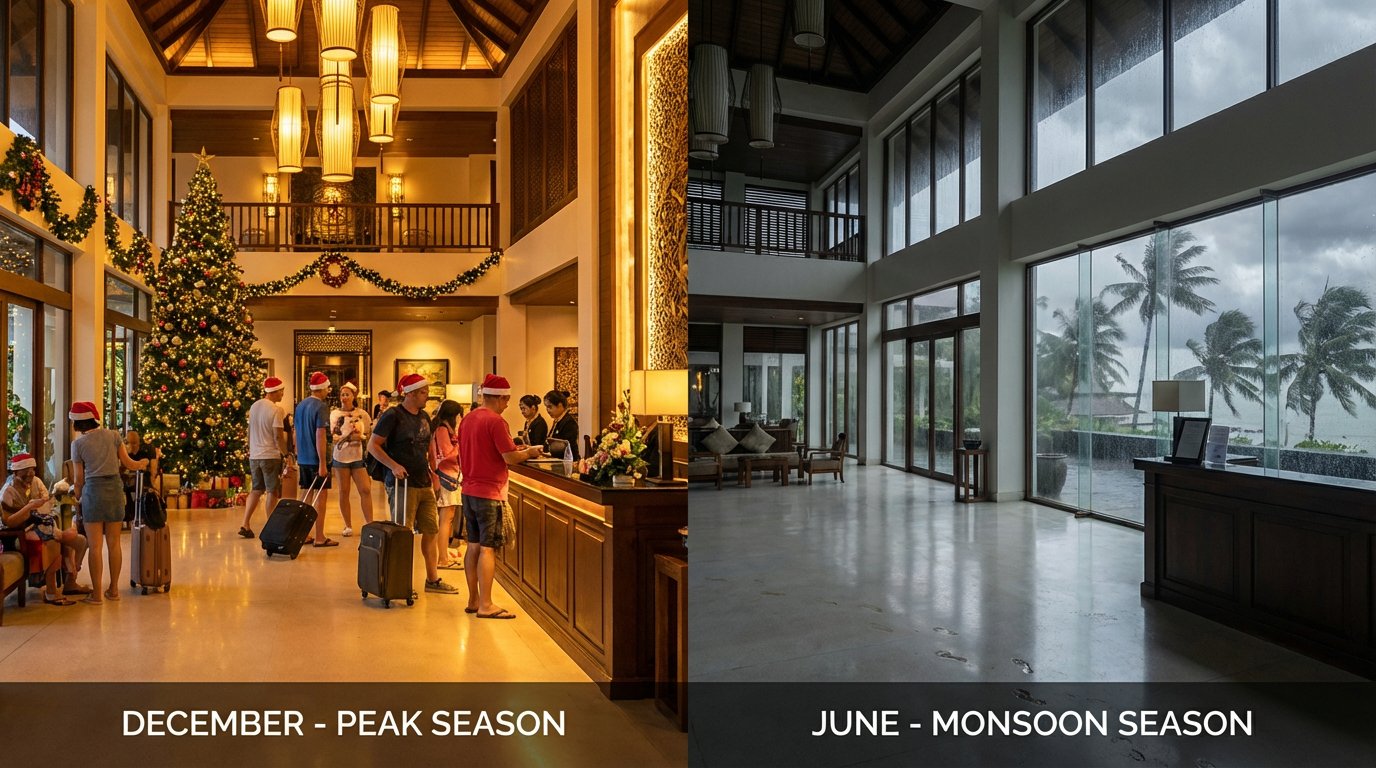
Something feels different about this high season. You’ve probably noticed it. Rates are up. Occupancy looks reasonable. Yet the energy isn’t quite there. The lobby doesn’t buzz the way it did in 2019. The guest mix has shifted. Your Chinese-speaking staff have less to do than they used to.
That gut feeling? The data backs it up.
Thailand’s 2024-2025 high season is a study in contradictions. Hotels are charging record rates while arrival numbers slide backward. Chinese tourists—once the backbone of Thailand’s tourism economy—have all but disappeared from some properties. And a wave of new hotel supply is about to crash into markets that can’t absorb it.
For GMs and multi-property managers trying to plan budgets, set rates, and allocate staff for the year ahead, understanding what’s actually happening—not what TAT press releases suggest is happening—matters more than ever.
The Numbers: A Season of Contradictions
Through December 7, 2025, Thailand recorded 30.27 million international visitors—down 7.19% from the same period last year. The initial government target of 39 million arrivals? Quietly revised down to 33 million.
But here’s where it gets interesting. Total tourism revenue hit 1.4 trillion baht despite the lower volume. Average spending per tourist rose to 46,000 baht, up 1.74% year-over-year. Fewer tourists, but each one spending more.
The industry is calling this “quality over quantity.” That’s a polite way of saying mass-market Chinese group tours have collapsed and hotels are scrambling to fill the gap with higher-spending guests who require different services and have different expectations.
Phuket: The Bright Spot
Phuket continues to outperform. First-half 2025 occupancy hit 79.5%, marginally up from 79.1% in the same period last year. ADR reached 5,652 baht—up 7.8% year-over-year. January peak occupancy touched 91.8%.
Current high-season rates in Phuket run 8,000 to 14,000 baht per night for mid-tier to upper-tier properties. Hotels are holding firm on pricing, and the market is absorbing it.
Bangkok: A Different Story
Bangkok tells a more sobering tale.
First-half occupancy dropped to 75%—down 3.7 percentage points from last year. ADR reached 4,260 baht, up a modest 3.3% that barely outpaces inflation. With 5,100+ new rooms entering the market in 2025 and another 16,641 in the pipeline across 68 projects, the supply-demand imbalance isn’t going away.
The mid-market and economy segments face the worst of it. Luxury properties command rate increases. Budget and mid-tier hotels slash rates while absorbing higher operating costs. The middle is getting squeezed.
The Chinese Elephant in the Room
Let’s talk about what everyone in Thai hospitality whispers about but few discuss openly: the Chinese tourist collapse.
Chinese arrivals to Thailand in 2025 are tracking around 4.1 million—down 33-34% from 2024. That’s the first time below 5 million Chinese visitors in 12 years. Chinese market share has collapsed from 28% in 2019 to 13.58% today.
For hotels that built their business around Chinese group tours—and there are many—this isn’t a soft patch. It’s an existential shift.
Why They’re Not Coming
The January 2025 kidnapping of Chinese actor Wang Xing made international headlines and triggered a cascade of cancellations. Within days, net booking volume for Thailand trips fell 15.6%. TAT reported 10,000+ immediate cancellations, primarily on chartered flights from second-tier Chinese cities.
But the kidnapping was a trigger, not the cause. Chinese traveler perception of Thailand’s safety dropped from 26% to 19% according to Dragon Trail International’s Chinese Traveller Sentiment Report. Thailand’s World Economic Forum safety ranking plummeted from 86 to 102.
The “Thailand is unsafe” narrative circulating on Chinese social media—fueled by call center scam stories, boat accidents, and reports of Chinese tourists targeting other Chinese tourists—has proven sticky. And Thailand’s competitors noticed.
Japan, with a weak yen making it 15% cheaper than 18 months ago, has stolen massive market share. Vietnam offers cheaper packages to similar beaches. Malaysia is right next door and visa-free.
The Chinese market is essential because they spend more and are adventurous… Thailand had lost six to seven million Chinese visitors.
What This Means for Your Property
If your hotel relied on Chinese group tours for base occupancy, 2025 forces a reckoning. Group tour business is down across the board. The Chinese travelers still coming are increasingly FIT (Free Independent Travelers)—different profile, different booking patterns, different service expectations.
Revenue management systems calibrated for predictable Chinese group blocks need recalibration. Staff trained to serve group tour guests need retraining. Marketing channels need repositioning.
The Chinese market will eventually recover. But waiting for that recovery isn’t a strategy.
The New VIPs: Who’s Actually Filling Rooms
For the first time in recent history, Malaysia—not China—is Thailand’s largest source market. Through the first half of 2025, Malaysia sent 2.3 million visitors compared to China’s 2.27 million.
That’s not a rounding error. That’s a fundamental market shift.
| Market | 2025 Performance | Key Stat |
|---|---|---|
| Malaysia | Now #1 market | 4.13M visitors (full year tracking) |
| China | Fallen to #2 | 4.02M visitors, down 34% |
| Russia | Surging | 833,000 to Phuket alone |
| India | Steady growth | 488,387 to Phuket |
| Germany | +71% in June | 156,297 seats booked Q1 2026 |
| UK | +19.3% through June | 117,489 seats booked Q1 2026 |
Europeans: The Long-Stay High-Spenders
European travelers have become Southern Thailand’s strongest tourism driver. They’re pushing hotel performance to record levels in Phuket and Samui, and they’re doing it by staying for weeks—not days.
The spending difference is substantial. Average tourist spending runs 46,000 baht per trip. Europeans average 60,000-70,000 baht ($1,600-1,900). That’s 30-50% above the mean.
Long-haul markets showed remarkable year-on-year growth through early 2025: UK arrivals up 19.3%, Germany up 11.82%. June 2025 saw German tourist arrivals jump 71% year-over-year.
Forward booking data tells the story: 156,297 seats booked from Germany for Q1 2026, up 7% year-over-year. UK bookings at 117,489 seats, up 11%.
Russians: The Steady Hand
Russia has become Phuket’s dominant market by sheer volume—833,000 visitors to Phuket alone, nearly double India’s numbers. TAT’s 2025 target of 2 million Russian visitors would set an all-time record.
Russian guests present specific characteristics:
- Extended winter escapes (staying months, not weeks)
- Family-oriented travel patterns
- Preference for all-inclusive packages (partly due to credit card restrictions)
- Strong repeat visit loyalty—Russians who find a property they like often return annually
The challenges are real: payment processing issues from credit card bans, language barriers, and aircraft shortages limiting seat capacity. But for properties that figure out the logistics, Russian guests provide reliable high-season base demand.
The Implication
Your guest mix has fundamentally shifted from 2019. Different nationalities have different service expectations, different complaint behaviors, and different review patterns.
Europeans are more likely to voice concerns directly and leave detailed reviews. Russians appreciate patience with language barriers. Neither expects the group-tour-style service that worked for Chinese markets.
Are your services adapted? Your amenities relevant? Your feedback systems capturing what these new guests actually think?
The Supply Tsunami Coming
While demand softens, supply accelerates.
According to Lodging Econometrics, Thailand’s hotel development pipeline hit an all-time high: 168 projects representing 43,381 rooms in various stages of development.
Bangkok leads with 68 projects and 16,641 rooms. Phuket follows with 40 projects and 10,194 rooms. In 2025 alone, Phuket adds 2,134 new rooms—more than double the 884 added in 2024.
By 2028, Phuket is projected to have 99,954 keys across 1,468 properties.
The math is unforgiving. Even when demand recovers, supply growth will pressure occupancy and ADR. The properties that thrive will be those that differentiate clearly—through service quality, reputation, and guest experience—rather than competing on rate.
Hotels with 4.5+ ratings on booking platforms will maintain occupancy and rate integrity. Those with 3.8 ratings will compete on price in an oversupplied market. The gap between winners and losers widens.
The Margin Squeeze Nobody’s Discussing
Hotels raising rates aren’t being greedy. They’re fighting for survival.
The cost pressures hitting Thai hospitality are stacking:
Wage increases: Minimum wage rose to 400 baht/day for Type 2-4 hotels (those with more than 50 rooms) effective July 2025. Depending on province, that’s a 12-18% increase. Wages now consume 25-30% of total revenue.
Property tax: Breaks that helped hotels survive the pandemic ended in 2024.
Energy costs: Rose from 2.90% to 3.30% of revenue.
The Thai Hotels Association estimates 6-8% increase in operational costs from wage hikes alone. For hotels already operating on thin margins in competitive markets, this isn’t absorbable without either raising rates or cutting service—and cutting service destroys the reviews that justify rates.
We are not opposed to higher wages – we know they improve workers’ lives and strengthen the economy. But applying the same rate to every hotel, in every province, ignores the huge differences in economic conditions and tourist demand.
THA has filed a legal challenge against the uniform wage rate, arguing that a 400-baht minimum makes sense in Bangkok or Phuket but devastates smaller hotels in secondary provinces with lower tourism demand.
The outcome matters less than the reality it reflects: operating costs are rising while arrivals are falling. Hotels that can’t pass costs through in rates—because their reputation doesn’t support premium pricing—face margin compression that threatens viability.
What Smart Hoteliers Are Doing
The hotels navigating this market successfully share common characteristics.
Protecting Rate Integrity
Phuket hotels are explicitly “avoiding discounting prices to compete,” according to industry reports. This is a strategic choice: long-term brand value over short-term occupancy.
The logic is sound. Discounting trains guests to expect discounts. It triggers rate-matching cascades as competitors respond. It damages margin without building loyalty. And research shows lowering prices for badly-rated properties provides no additional value in consumers’ minds—guests don’t suddenly forgive poor service because it’s cheap.
Pivoting Marketing
Hotels repositioning away from China aren’t abandoning the market—they’re diversifying. Marketing spend is shifting toward Europe, India, and Russia. Messaging emphasizes experiences over price, targeting guests who stay longer and spend more.
Properties that previously courted group tours are building direct booking channels and OTA profiles that attract independent travelers. Different distribution strategy, different guest expectations, different operational requirements.
Understanding the New Guest
Different source markets have different expectations. European guests value independence, authentic local experiences, and staff who can discuss recommendations. Russian guests appreciate patience with language barriers and all-inclusive clarity. Both value efficiency and responsiveness over elaborate formality.
Properties succeeding in this market are actively learning what their new guests want—not assuming they want what the old guests wanted.
Building Reputation Capital
With supply increasing and demand uncertain, reputation becomes the competitive moat. Properties with strong review profiles attract bookings without discounting. Properties with weak profiles compete on rate in a market that punishes rate competition.
Building reputation takes time. The reviews you generate this high season will influence bookings through mid-2026. The window to build that capital is now, when you have maximum guest volume.
Why Feedback Matters More This Season
Four factors make guest feedback particularly critical right now.
Higher rates require higher standards. Guests paying 8,000-14,000 baht/night in Phuket expect flawless experiences. They notice small failures. They feel entitled to perfection—and to complain when they don’t get it. The price-expectation relationship is non-linear: at premium rates, guests become more demanding, not less.
Peak season generates maximum review volume. More guests checking out means more reviews being written. Those reviews will be the “fresh” reviews potential guests read when booking trips for the next 6-8 months. Your reputation for 2026 is being written right now.
New guest profiles require understanding. You can’t optimize service for European long-stay guests if you don’t know what they actually want. You can’t adapt for Russian families if you’re guessing at their expectations. Systematic feedback reveals patterns that intuition misses.
Staff strain creates service gaps. Thailand’s hospitality workforce is 25% smaller than pre-pandemic. Remaining staff are stretched thin, managing more guests with fewer resources. Under those conditions, service failures become more likely. The question is whether you catch them before guests post publicly—or after.
The Opportunity
One bad review can deter 30 potential guests who read it. But one good review during peak season gets maximum visibility—highest volume of travelers researching, highest recency weight on booking platforms.
Hotels that capture feedback in real-time can intercept problems before they become reviews. Hotels that wait for post-checkout surveys learn about issues too late to fix them.
The difference between “the AC in room 412 wasn’t cooling properly” heard at 2pm on day one versus the same complaint posted on TripAdvisor two weeks later? The first is a maintenance ticket. The second is marketing damage that persists for months.
The Season of Reckoning
The 2024-2025 high season is a reality check for Thai hospitality. The old playbook—wait for Chinese groups, fill rooms, repeat—is obsolete. Hotels that assumed 2019 patterns would return have spent five years waiting for a train that took a different route.
The hotels thriving in this market share three characteristics:
They understand their new guest mix. Not generically, but specifically—what Europeans expect versus Russians, what long-stay guests need versus short-stay guests, what independent travelers value versus what group tours valued.
They maintain rate integrity through superior experience. They’ve accepted that competing on price in an oversupplied market with rising costs is a losing strategy. They compete on reputation instead.
They catch problems before problems become reviews. They’ve figured out how to capture guest sentiment during stays, not after checkout, and they’ve built systems to act on that feedback fast enough to matter.
The supply tsunami is coming. Chinese recovery may take years. Costs aren’t going down. In that environment, reputation isn’t a “nice to have.” It’s the asset that determines whether your property thrives or gets squeezed out.
High season is when you build that reputation—or destroy it.
Want to understand what your guests actually think before they post it publicly? GuestMetrix helps Thai hotels capture real-time feedback, identify issues during stays, and build the reputation that sustains pricing power. Start a free 60-day pilot and see what you’ve been missing.
Frequently Asked Questions
How much have tourist arrivals to Thailand declined in 2025?
Why have Chinese tourist arrivals to Thailand dropped so dramatically?
Which countries are now Thailand's largest tourism source markets?
How is the hotel supply pipeline affecting Thai markets?
How much did minimum wage increase for Thai hotels in 2025?
Related Resources
- Thailand Hotel Industry 2025: Navigating Declining Arrivals and Rising Competition - Our comprehensive analysis of market challenges facing Thai hospitality
- How to Prevent Bad Hotel Reviews Before They’re Posted - The operational framework for catching issues during stays
- QR Codes for Guest Feedback: Complete Implementation Guide - Step-by-step setup for hotels, restaurants, and spas
Sources and Data
This analysis draws on official statistics and industry data from verified sources:
- Thailand welcomes 15 million foreign tourists, Malaysia surpasses China - Nation Thailand, 2025
- Chinese tourism to Thailand faces sharp decline amid safety concerns - Nation Thailand, 2025
- Chinese travelers cancel Lunar New Year trips to Thailand over safety concerns - CNBC, January 2025
- Thai Hotels Association challenges minimum wage hike over unequal impact - TTG Asia, August 2025
- Phuket Leads Thailand’s Tourism Recovery as Russian Arrivals Continue to Surge - Travel And Tour World, 2025
- Asia Pacific Hotel Development Trends & Projections – Summer 2025 - Lodging Econometrics
- Thailand targets 8 million European tourists in 2025 - Bangkok Post
- UK, Germany, France drive strong growth in Thailand’s long-haul tourism - Travel And Tour World, 2025
Tags


Ready to improve guest satisfaction?
Start your free 60-day pilot program today. No credit card required.